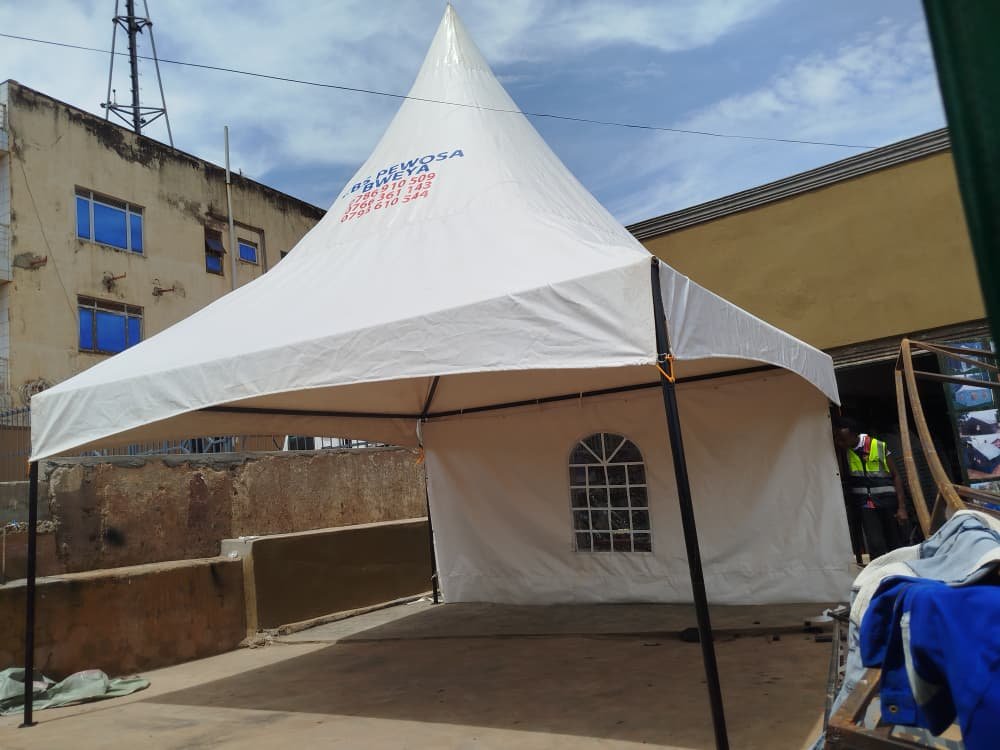
Why the 4.5m x 4.5m “50-Seater” Tent is Uganda’s Most Practical Utility Structure
In the tent manufacturing and event layout industry, bigger isn’t always better. While massive high-peak marquee structures grab attention at sprawling functions, savvy event planners, business owners, and local institutions often rely on a much more compact workhorse: the 4.5m x 4.5m frame tent.
Commonly referred to across Uganda as a “normal-sized 50-seater,” this specific dimension strikes an ideal balance between spatial economy and high-capacity shelter. To understand why this layout has become a staple for fabricators like Eratent Shades and Tents along Jinja Road in Banda, one must look at how it maximizes tight physical spaces while offering uncompromising durability.
Decoding the Capacity: How Does a 4.5m x 4.5m Space Seat 50 People?
To the untrained eye, a 4.5-meter by 4.5-meter square footprint (totaling approximately $20.25$ square meters of floor space) might seem modest. However, when configured properly by event coordinators, it handles a 50-person crowd with surprising ease.
The secret lies entirely in the seating style:
- The “Theater Style” Setup: This layout mimics a lecture hall or cinema, utilizing rows of standard plastic chairs facing a single direction without tables. Because a single plastic chair requires less than 0.4 square meters of space, a 4.5m x 4.5m tent can comfortably shelter 50 seated individuals while leaving a central aisle for movement.
- The Alternative Uses: When not packed to maximum capacity for a meeting, this exact size transitions smoothly into hosting about 20 to 25 people around small cocktail tables, or serving as a catering buffet sanctuary at larger functions.
Key Advantages of the Normal-Sized 50-Seater
For organizations looking to purchase a durable asset rather than continuously paying rental fees, investing in this specific dimension offers several distinct operational benefits.
1. Extreme Footprint Versatility
Kampala’s residential compounds, commercial packing lots, and restaurant backyards are becoming smaller and more tightly structured. A massive tent simply won’t fit without damaging landscaping or blocking vital pathways. The 4.5m x 4.5m footprint fits effortlessly into tight urban spaces, making it a favorite for intimate family gatherings, church overflow zones, or emergency community meetings.
2. Rapid Deployment and Low Labor Costs
Unlike massive multi-span tents that require a large crew, heavy tools, and hours of labor to erect, a 4.5m x 4.5m frame tent can be safely pitched by a small team of two to three people in a short window of time. This makes it highly responsive for sudden events, such as community vigils (lumbe) or flash corporate product samplings.
3. Reduced Wind Resistance and High Structural Integrity
Uganda’s tropical storms can bring sudden, violent winds that test the limits of outdoor fabric structures. Because a 4.5m x 4.5m tent has a lower surface area and a compact, symmetrical square profile, it cuts through heavy winds much more efficiently than sprawling rectangular designs. When manufactured using heavy-duty, galvanized steel poles and high-tensile PVC canvas, these units stand remarkably secure in adverse weather conditions.
What to Look for in a Quality 4.5m x 4.5m Tent
Because this size is highly sought after across the central region, the market features varying levels of quality. Experts note that buyers should look closely at the specifications before making a purchase.
Premium manufacturers, such as the team at Eratent located next to the Stabex petrol station in Banda, emphasize heavy-gauge fabrics (typically 550 GSM to 650 GSM PVC) that are 100% waterproof and UV-treated to endure the intense Ugandan sun without cracking or fading. Furthermore, a sturdy frame should utilize galvanized industrial steel pipes rather than lightweight aluminum or ungalvanized iron, ensuring that the structural skeleton resists rust and withstands repeated assembly and disassembly over many years.
Ultimately, the 4.5m x 4.5m “50-seater” proves that smart engineering and practical dimensions are often the most valuable assets a business or community group can own.